
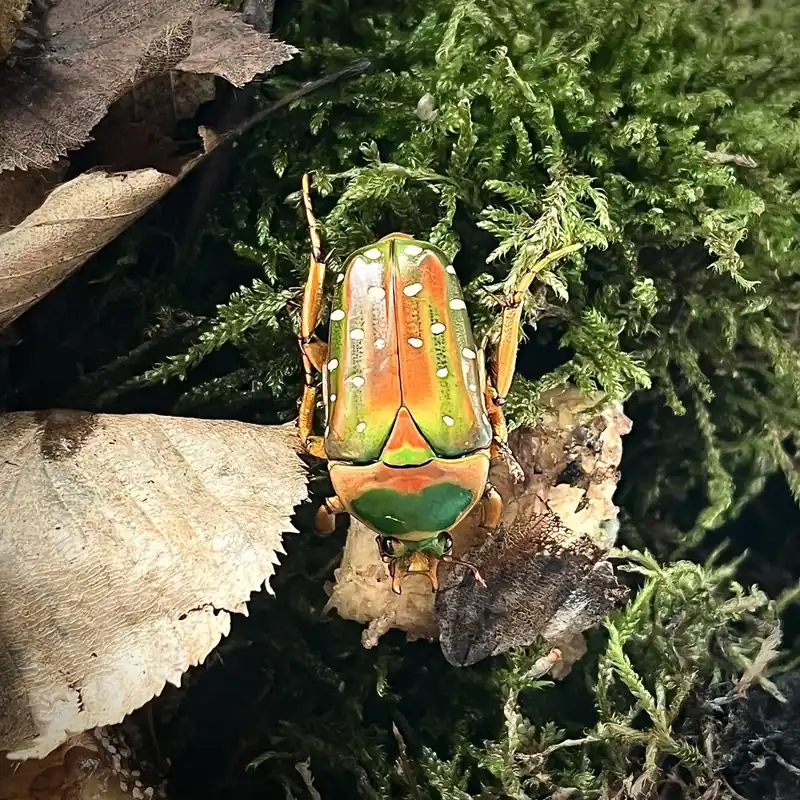
Stephanorrhina guttata – Vairant Beetle – couple Pouze Dnes
Původní cena byla: 18,55 Kč.9,28 KčAktuální cena je: 9,28 Kč.
Doprava zdarma při objednávce nad 999,00 Kč
- Vaši objednávku doručíme rychle a nabízíme bezplatnou dopravu.
- 30denní možnost vrácení a refundace

Popis
Stephanorrhina guttata
The Stephanorrhina guttata beetle is one of the most charming and popular species of African flower beetles, instantly captivating breeders with its brilliant coloration. Its body boasts a fascinating emerald green metallic shine, which is heavily dotted with sharp, contrasting white spots on both the elytra and the pronotum. Thanks to its jewel-like appearance, high diurnal activity, and absolute ease of breeding, it is an ideal species for any terrarium, where a group creates a beautiful and dynamic spectacle.
Basic parameters:
- Scientific name: Stephanorrhina guttata
- Family / Subfamily: Scarabaeidae / Cetoniinae
- Origin: West and Central Africa (e.g., Cameroon, Nigeria)
- Size: 2.53.0 cm (1.01.2 in); a smaller but chunky and visually striking species.
- Lifespan: Larval development takes 46 months, and the adult beetle lives for another 35 months.
- Temperament: A very active, diurnal, and peaceful species. Representatives of this genus fly often and gladly.
- Type: Terrestrial and arboreal (they love to climb branches and explore the upper levels of the terrarium).
- Difficulty: Very low. It is a highly resilient and prolific species.
- Suitability for beginners: Absolutely ideal. It handles minor temperature fluctuations and is the perfect starter species.
and appearance:
The most striking feature of this species is its metallic green base color with numerous pure white dots. The shade of green can change depending on the lighting, sometimes shifting into slightly copper or golden tones. Sexual dimorphism is less conspicuous than in massive species; however, males feature a small forked projection (a tiny horn) on the front of the head and have longer front legs. Females have a smooth head and appear slightly stockier overall.
Housing and terrarium equipment:
- Terrarium size: Given their smaller size, a 1520 liter terrarium is perfectly adequate for a group of 1015 individuals.
- Temperature and humidity: A temperature between 2226 °C (7279 °F) is recommended. Maintain humidity around 6075 % by regularly misting the substrate surface.
- Equipment: Since the beetles are very active flyers, the terrarium must be well-secured. Provide them with plenty of crossed branches and pieces of bark for safe climbing.
Substrate (the most important part of breeding):
- Composition: They are completely undemanding. A standard mix of leaf litter and decaying white wood (1:1) is more than enough. To encourage larger adults, a little fermented substrate (flake soil) can be added.
- Layer height: Ideally 15 cm (6 in). Females like to lay eggs in the lower, slightly compacted, and moister layer.
Diet:
- Adults (imago): The fundamental and by far the best food choice for them is fresh, soft, and sweet fruit (e.g., ripe banana, mango, peach, or sweet melon). This fruit provides them not only with the necessary sugars for energy but also with natural hydration and vitamins that chemical jellies can never fully replace. Serve the fruit regularly and do not let it mold in the terrarium.
- Larvae: They are undemanding and feed on the leaves and wood in the substrate. Protein supplementation is not strictly necessary for this species, but occasionally adding dried gammarus or a piece of dog kibble can lead to more robust individuals.
Co-habitation and possible risks:
- Adults: Completely problem-free. There is no aggression or mutual mutilation; on the contrary, group keeping is highly desirable and attractive.
- Larvae: They are not cannibalistic. If they have enough food and space, an entire generation of larvae can be raised together in one large breeding box.
Reproduction and development:
Mating occurs frequently directly on the substrate surface or at the feeding station. Females are highly prolific and lay dozens of eggs in the substrate. Larvae grow steadily, and at the end of the L3 stage, they construct an oval cocoon out of substrate, about the size of a quail egg, often gluing it to the bottom of the container. The initial coloration of a freshly hatched beetle fully develops and hardens after leaving the cocoon.
Overview of developmental stages:
| Developmental stage | Approximate duration | Breeding notes |
|---|---|---|
| Egg | 34 weeks | Laid in large numbers in the compacted substrate. |
| Larva (L1, L2, L3) | 46 months | Can be kept together; they consume substrate very quickly. |
| Pupa (in cocoon) | 1.52 months | Solid earthen cocoons that are best left undisturbed. |
| Adult (imago) | 35 months | Require a regular supply of food (fresh sweet fruit). |
Související produkty
-
Sleva!

Akční Cena Dajana Holiday block
Původní cena byla: 35,00 Kč.17,50 KčAktuální cena je: 17,50 Kč. Přidat do košíku -
Sleva!
Seachem Fresh Trace 250 ml Časově Omezené
Původní cena byla: 211,00 Kč.84,40 KčAktuální cena je: 84,40 Kč. Přidat do košíku -
Sleva!
Seachem Entice 250 ml Horká Nabídka
Původní cena byla: 228,00 Kč.91,20 KčAktuální cena je: 91,20 Kč. Přidat do košíku -
Sleva!

Tetra Min Weekend 20 tablet Oblíbený
Původní cena byla: 96,00 Kč.48,00 KčAktuální cena je: 48,00 Kč. Přidat do košíku